

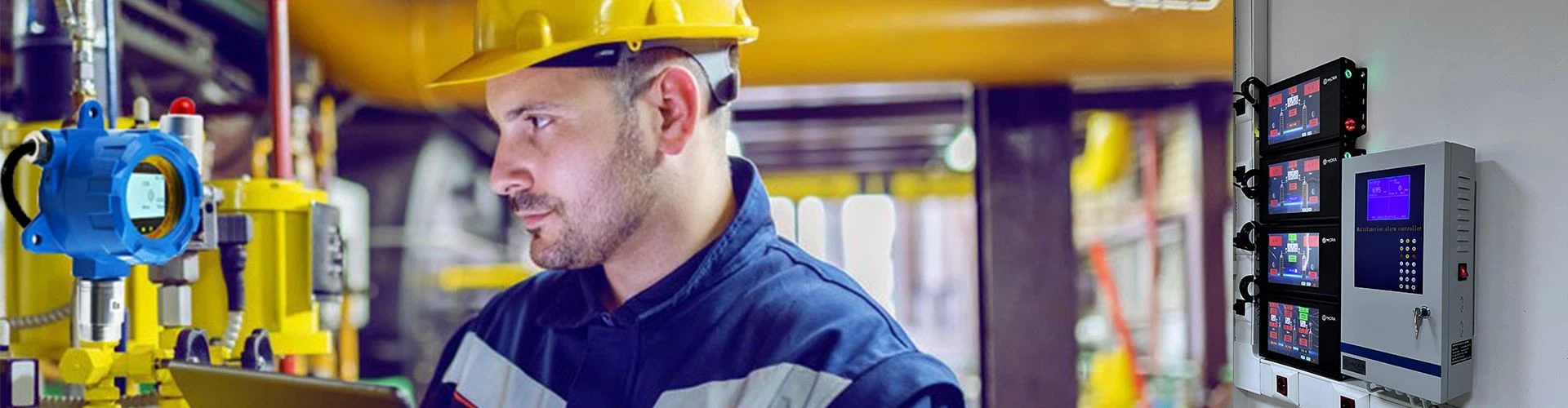


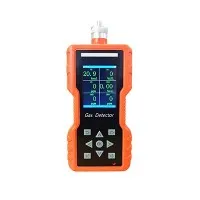


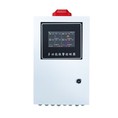

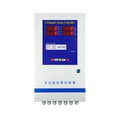
The internal linkage of the combustible gas alarm detector refers to the start and close of the external control equipment (fan and gas solenoid valve) directly controlled by the gas alarm control host, rather than controlled by the linkage control box, and the gas alarm control host comes with multiple groups of passive/active programmable linkage output.
In the combustible gas leakage monitoring system, the combustible gas detector will transmit the detected concentration of combustible gas to the combustible gas alarm control host, once the gas concentration reaches the low limit alarm value, the control host will issue an audible and visual alarm, and output a low limit alarm signal (hold signal) to start the exhaust fan and reduce the combustible gas concentration on site. If the detector detects that the concentration of combustible gas continues to rise and reaches the high limit alarm value, the control host will output the high limit alarm signal (pulse signal) to start the emergency cut-off solenoid valve and cut off the air source. The gas alarm can be directly connected to the exhaust fan with the power ≤200W. To connect to the fan with the power > 200W, use a 220V AC contactor.
Solenoid valve is divided into two kinds: one is normally open pulse solenoid valve, when receiving the pulse signal output of the combustible gas alarm control host, the valve is closed to prevent the gas flow. AC220V or DC24V power supply can be used. There is also a self-holding gas solenoid valve for the use of AC220V power supply, which can be kept normally open or normally closed without any power (bistable).

Combustible gas detector installation position, installation Angle, protective measures and system wiring should be anti-electromagnetic interference. There are three main ways that the electromagnetic environment affects the combustible gas detector: the electromagnetic interference in the air, the narrow pulse group of the power supply and other input and output lines and the static electricity of the human body. For example, when the combustible gas detector is close to the air conditioning installation, it will cause the detection deviation of the system; Detection line and power line, lighting line and other strong lines spacing is small, and no anti-electromagnetic interference measures, the system will also produce detection deviation.
When the place where the combustible gas detector is installed needs to install an exhaust fan, if the exhaust fan is set adjacent to the combustible gas detector, the leaking flammable gas will not be able to fully diffuse to the vicinity of the combustible gas detector, resulting in timely detection and missed aircraft. Pay attention to the setting of combustible gas detectors in explosion-proof places, such as Class A workshops that emit combustible gases should choose explosion-proof combustible gas detectors, and their explosion-proof levels should not be lower than the corresponding explosion-proof level requirements of the current specifications. In the process of combustible gas detector, attention should be paid to the factors that are easy to cause failure, such as: dust, high temperature, humidity, rain, etc. In the process of using the detector, the air conditioning and heating equipment is installed near the combustible body detector. When using the air conditioning and heating equipment, if the cold and heating flow directly blows through the combustible gas detector, it is possible to cause the resistivity of the platinum wire of the combustible gas detector to change and error occurs. Therefore, the combustible gas alarm should be away from the air conditioning and heating equipment. Avoid faults caused by improper Settings.