





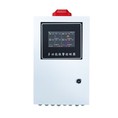

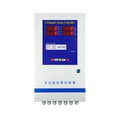
Do you know how many detection principles of gas alarm?
At present, the detection principles of gas alarm includes catalytic combustion, semiconductor, electrochemical, infrared and PID. Different detection principles reflects different sensor types.
How to choose the different sensor? It bases on the different application occasions and gas.
1.Catalytic combustion type
Catalytic combustion type gas sensor is to use the heating effect of the catalytic combustion principle, made up of detecting element and compensating element matched measuring bridge, under the condition of a certain temperature, the combustible gas in detecting element carrier surface and under the action of catalyst flameless combustion, carrier temperature rise, through its internal platinum resistance also rise accordingly, so as to make the balance bridge out of balance, output an electrical signal is proportional to the concentration of combustible gas.The concentration of combustible gas is known by measuring the resistance of the platinum wire.
It is mainly used for the detection of combustible gas, with good linearity of output signal, reliable index, cheap price, explosion-proof design will not cross infection with other non-combustible gas.It is also widely used in the detection of combustible gas in industrial field. However, the drawback is that not all combustible gas can be used for catalytic combustion. Some macromolecules of organic matter, such as benzene, do not react to such sensors.On the other hand, the measurement accuracy of this sensor is LEL level, which is much higher than PPM level, so it can only be used for high concentration gas detection.
Note: the realization of catalytic combustion detection is conditional. The detection environment must contain enough oxygen. In the absence of oxygen, this detection method may not be able to detect any combustible gas.

2.Semiconductor type
Semiconductor sensor is an impedance device made of a thin film of metal oxide, whose resistance varies with the amount of gas.The reduction reaction of gas molecules on the surface of the film causes the change of electrical conductivity of the sensor.An oxidation reaction must occur in order to remove the gas molecules from their initial state.The heater inside the sensor can accelerate the oxidation process, which is why some low-end sensors are always unstable. The reason is that there is no heating or the heating voltage is too low, resulting in too low temperature and insufficient reaction.Or the change of the external temperature has a relatively large impact on it.
Semiconductor sensor has been widely used in combustible gas alarm because of its simple and low price, but also because of its poor selectivity and stability is not ideal as well as its own heat, not explosion-proof, is still only used in civil level.
Note: although semiconductors (solid state) have a longer life expectancy, they are also more susceptible to interfering gases than other types of sensors.Therefore, if other background gases are present in the application, the solid state sensor may give false alarm.
3.Electrochemical type
Electrochemical sensors are widely used in almost all industrial occasions due to their good selectivity and high sensitivity. Electrochemical gas sensors are used to detect the concentration of gas by detecting the current. They are divided into galvanic cell type that does not need power supply and controllable potential electrolysis type that needs power supply.The main advantages of electrochemical sensors are high sensitivity and selectivity of gases.The downside is that the life limit is generally two years.There are few types of gases that can be measured, and some organic ones, such as benzene, toluene and xylene, cannot be tested.
Note: (1) some sensors require bias voltage between electrodes.It takes 30 minutes to 24 hours for the sensor to stabilize and three weeks to remain stable.
(2) high humidity and high drought will affect the service life of the sensor.Instantaneous pressure change may produce a transient sensor output, or it may reach a false alarm state.

4.Infrared type
Infrared sensor, using the principle of infrared chromatographic absorption of gas, is almost the most perfect sensor at present, belongs to the precise sensor, it has a good measurement pertinence.At present, low carbon chain hydrocarbons and CO2 are mainly detected.
5.Light ion sensor PID
With an ultraviolet light source, the chemical is excited to produce positive and negative ions that can be easily detected by the detector.Ionization occurs when molecules absorb high-energy ultraviolet light, and the molecules are excited to produce negative electrons and form positive ions.The electric current generated by these ionized particles is amplified by the detector, and PPM levels are displayed on the meter.These ions pass through the electrode and quickly recombine to form the original organic molecules.There is no damage to the molecules in the process.
Note: PID is used to detect gases that can be ionized by uv, otherwise useless.
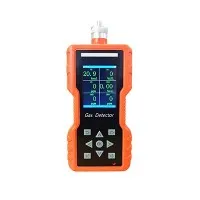
 New product: Portable color screen 4 gases in 1 detector Detection gas: oxygen, carbon dioxide, combustible gas and toxic gas, temperature and humidity, can be customized gas combination. Detection principle: electrochemical, infrared, catalytic combustion, PID. Alarm mode: sound-light, vibration Battery capacity: 5000mAh Communication interface: Micro USB Data storage: 990,000 real-time records and over 3,000 alarm records Weight: 293 g Standard equipped: manual, certificate, USB charger, packing box, back clamp, instrument, calibration gas cover. For more informations,welcome contact with us at any time,thank you. |