


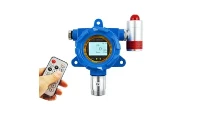

1.Portable gas detector
Portable gas detector is a kind of compact equipment designed for rapid field detection. These detectors are lightweight and easy to carry, and some can even be worn on the body or used in a hand. The built-in high-precision sensor enables qualitative or quantitative analysis of specific gases such as methane, hydrogen, carbon monoxide, hydrogen sulfide, etc. The portable detector is usually equipped with a digital display that displays the gas concentration in real time and sets an adjustable alarm threshold. Once the gas concentration is detected to exceed the safe level, it will issue an audible, visual or vibration alarm to ensure the safety of field workers.
2.Fixed gas detector
A stationary gas detector is a monitoring device that is permanently installed in a specific location as part of an industrial safety system to continuously monitor gas concentrations in the environment. These detectors can be point or open and installed near potential sources of gas leakage, such as chemical plants, oil refineries, gas stations, tunnels, etc. By analyzing gas samples in real time, the stationary detector can immediately trigger an alarm system when the gas concentration reaches a preset dangerous level, notifying field personnel to take emergency measures. It may also be linked to automated equipment such as ventilation systems and shut-off valves to prevent accidents.
3.Catalytic combustion sensor
The catalytic combustion sensor consists of two highly sensitive platinum electrodes, which are coated with a catalyst. When the combustible gas comes in contact with the catalyst on the electrode, it causes a chemical reaction, which results in the combustion of the gas. This combustion generates heat, which is detected by the second platinum electrode.
4.Electrochemical sensor
Electrochemical sensor is a detection tool that converts chemical information into electrical signals for gas detection. This sensor contains one or more electrodes that react chemically with the gas to be measured to produce a change in current. The advantages of electrochemical sensors include high sensitivity, good selectivity and low maintenance costs. Suitable for detecting a variety of toxic or harmful gases, such as carbon monoxide, hydrogen sulfide, oxygen, etc. The electrochemical sensors are designed for long-term stable operation and provide real-time readings of gas concentrations.
5.Infrared sensor
Infrared sensors use specific gas molecules to absorb or emit specific wavelengths of light in the infrared spectrum to detect gases. When the light emitted by the infrared light source passes through the light path containing the gas to be measured, the specific wavelength of light will be absorbed by the gas molecules. There are different types of infrared sensors, including NDIR (non-dispersive infrared) and FTIR (Fourier transform infrared). The ability to detect a wide range of gases from a single gas to complex mixtures with high precision, fast response and non-contact measurements.
6.Semiconductor sensor
When a specific gas molecule is in contact with the surface of a semiconductor material, it causes an oxidation or reduction reaction of the material, resulting in a change in electrical conductivity. This change is proportional to the concentration of the gas, and the presence and concentration of the gas can be detected by measuring the change in electrical conductivity. Semiconductor sensors are widely used in domestic and industrial environments for gas detection due to their miniaturization, low cost, fast response and high sensitivity to specific gases, such as detecting natural gas, alcohol vapor, carbon monoxide and so on. Semiconductor sensors can be affected by temperature and humidity, and appropriate compensation mechanisms are required to ensure accuracy.