


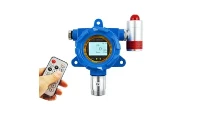

The acetylene gas alarm detector is a fixed acetylene concentration detection system, which is composed of a gas detector and a gas alarm controller. The detector is placed at the site where acetylene is used, and the core component sensor senses the on-site concentration of acetylene in real time; controls The detector is placed in the duty room or rest room, and personnel are required to monitor the concentration value detected by the detector in real time. Once the concentration exceeds the standard, an alarm will be issued to detect and handle it in time.
1.Features:
(1). The detector and controller are connected through cables and provide 220V power supply to achieve real-time monitoring;
(2). Adopt advanced microcomputer processing technology and have fast response speed;
(3). Use high-quality catalytic combustion sensors with high detection accuracy;
(4). The gas detector can be used alone, and on-site display and audible and visual alarm controllers can be added, and only 24V power supply is required;
(5). It can be uploaded to intelligent systems such as PLC and DCS, and can also be linked to external devices such as exhaust fans and solenoid valves.

2.Precautions when using:
Once the fixed installation of the acetylene alarm is in place, it is not recommended to change its position frequently. The following points should be considered when using it.
(1) Understand the possible leak points of the device to be monitored, analyze their leak pressure, direction and other factors, and draw a probe location distribution map, which is divided into three levels: I, II and III according to the severity of the leak.
(2) Based on specific factors such as the airflow direction and wind direction of the location, determine the direction of toxic gas leakage when a large leakage occurs.
(3) Based on the density of the leaked gas (greater or smaller than air), combined with the air flow trend, a three-dimensional flow trend diagram of the leakage is synthesized, and an initial setting point plan is made at the downstream position of its flow.
(4) Study whether the leakage state at the leakage point is micro-leakage or spray-like. If it is a slight leak, the setting point should be closer to the leak point. If it is a spray leak, move slightly away from the leak point. Based on these conditions, a final site setting plan is drawn up. In this way, the quantity and variety to be purchased can be estimated.
(5) For places with large toxic gas leaks, a detection point should be set up every 10-20m apart according to relevant regulations. For small, unattended and discontinuously operating pump rooms, attention needs to be paid to the possibility of toxic gas leakage, and a detector should generally be installed at the downwind outlet.
(6) For places with hydrogen leakage, the detector should be installed on the plane above the leakage point.
(7) For media with gas density greater than air, the detector should be installed on a plane below the leak point, and attention should be paid to the characteristics of the surrounding environment. Special attention should be paid to the setting of safety monitoring points in places where toxic gases are prone to accumulate.
(8) For open toxic gas diffusion and escape environments, if there is a lack of good ventilation conditions, it is easy for the toxic gas content in the air in a certain part to approach or reach the lower explosion limit concentration. These are safety monitoring points that cannot be ignored. . According to the analysis results of on-site accidents, more than half of them are caused by incorrect installation and calibration. Therefore, it is necessary to introduce correct installation and calibration precautions to reduce failures.