


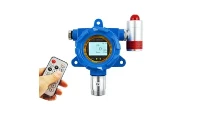

In industrial gas safety systems, the 4-in-1 gas detector is an essential piece of standard safety equipment for frontline personnel. However, many enterprises and safety managers make equipment selection errors that significantly compromise the user experience. For instance, using a diffusion-type detector for confined space entry allows only for a surface-level scan at the entrance, failing to capture the actual gas concentrations within the space; conversely, purchasing expensive pump-suction equipment for routine inspections in open areas results in unnecessary waste of resources. More critically, incorrect selection can easily create "blind spots" in gas detection, posing serious risks of poisoning or asphyxiation accidents. The following outlines the key differences between the two types of devices to assist you in making the right choice.
1.Fundamental Differences in Principle: The essential distinction lies in the gas sampling method, which directly determines their respective application scenarios and performance characteristics.
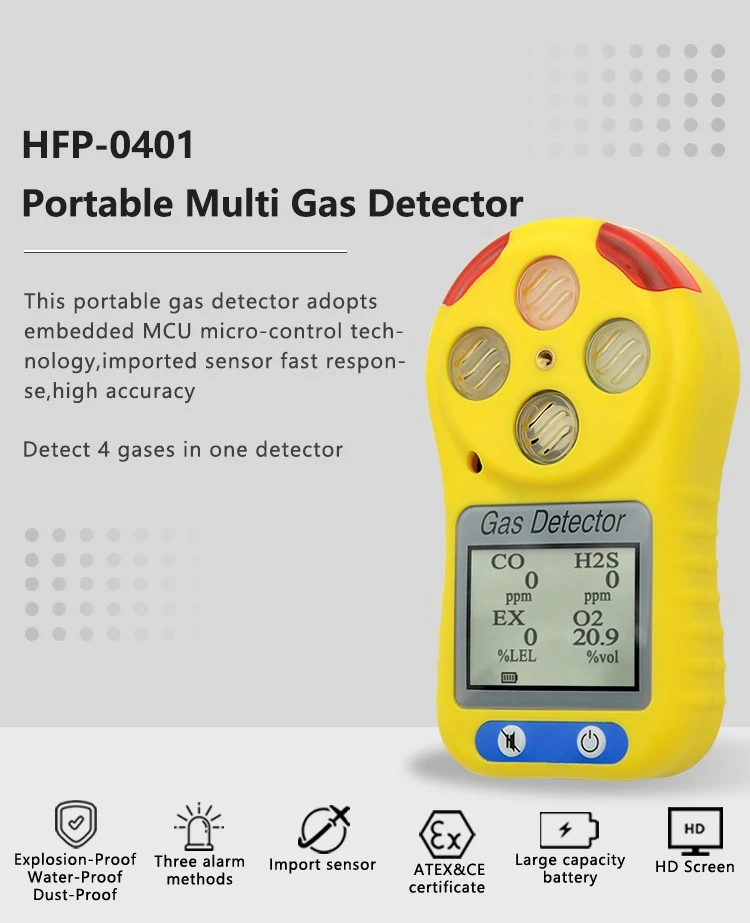
(1). Diffusion-Type 4 in 1 Gas Detector Portable
Core Principle: Relies on the natural diffusion of gases, allowing ambient gas to drift into the sensor inlet for detection without the need for an external power source. This design features a simple structure with no moving parts, resulting in a low failure rate and long battery life; it is currently the most widely used standard 4-in-1 detector.
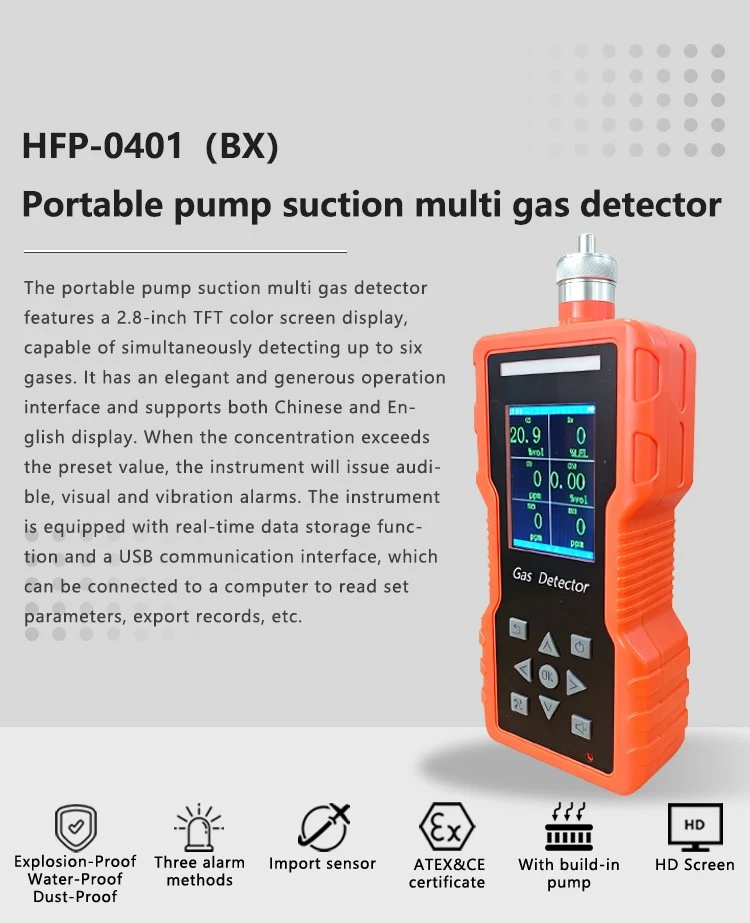
(2). Pump-Suction Gas Detector With Pump
Core Principle: The device features a built-in micro-pump that generates negative pressure to actively draw gas samples whether from a distance or within a confined space through a sampling tube and into the sensor for analysis. This design overcomes the limitations of diffusion-based detectors regarding long-range sampling and is specifically engineered for complex or confined monitoring environments.
2. Pros, Cons, and Application Scenarios
(1). Diffusion-type 4-in-1 Gas Detector
A.Key Advantages:
High cost-performance ratio: Simple structure and low production costs result in a price 20%–30% lower than pump-suction models with similar specifications;
Longer battery life: No power consumption from an air pump allows for 12–16 hours of continuous operation on a full charge, meeting full-day work requirements;
Simple maintenance: No complex gas pathways or filter elements; routine maintenance involves only cleaning the sensor inlet, resulting in low long-term upkeep costs;
Compact size: Lighter weight (typically ≤300g) makes it comfortable to hold in one hand and suitable for carrying on one's person for extended periods.
B.Key Disadvantages:
Zero sampling distance: Can only detect gas concentrations within a 30cm radius of the device; unable to detect gas at a distance or deep within confined spaces;
Slower response speed: In poorly ventilated environments, it takes longer for gas to diffuse to the sensor, potentially causing detection lag;
Detection blind spots: Cannot rapidly detect gas accumulation at varying heights-such as hydrogen sulfide (heavier than air) or methane (lighter than air)-without moving the device.
C.Application Scenarios:
Routine mobile inspections in open workshops or plant areas;
Personal protection for workers, monitoring surrounding gas concentrations in real-time;
Gas safety verification around a work site prior to hot work;
Detection in well-ventilated, semi-open spaces.
(2). 4-in-1 pump suction gas detector
A.Key Advantages:
Long sampling distance: Comes standard with a 1-meter sampling hose (extendable up to 15–20 meters), allowing for gas concentration detection inside confined spaces without requiring personnel to enter the hazardous area;
No detection blind spots: The sampling hose allows for flexible detection at upper, middle, and lower levels of a space, as well as in corners, pipe connections, and other spots where gas tends to accumulate;
Fast response speed: Active air intake ensures gas reaches the sensor quickly; response time is ≤30 seconds, making it more sensitive than diffusion-type models;
Higher safety: When inspecting confined spaces, personnel can operate from a safe location outside, avoiding direct exposure to hazardous environments.
B.Key Drawbacks:
Higher Price: Includes a built-in air pump and sampling system, resulting in higher manufacturing costs;
Shorter Battery Life: Continuous pump operation consumes power; the device runs for approximately 8–12 hours on a full charge;
More Complex Maintenance: Requires periodic replacement of air path filter elements to prevent dust and moisture from clogging the air lines and sensors.
C.Applicable Scenarios:
Confined Space Operations: Pre-entry testing for enclosed spaces such as sewage pits, septic tanks, reaction vessels, storage tanks, and underground utility tunnels;
Enclosed Pipeline Inspection: Detecting gas leaks inside gas pipelines, industrial piping, and sewer systems;
High-Altitude or Low-Lying Area Inspection: Monitoring locations that are difficult to access directly, such as elevated pipelines or deep underground shafts;
Emergency Rescue: Rapid detection and risk assessment at the scene of gas leak incidents.