


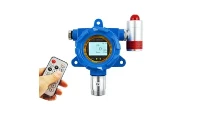

What are the output signals of fixed gas detectors?
The signal outputs of fixed gas probes include the following:
1. 4-20mA output
The4-20mA analog gas detection transmitter is an instrument produced by our company that can continuously detect the concentration of toxic, harmful, flammable and explosive gases in the working environment. The output mode is two-wire or three-wire. The three-wire gas transmitter can output a set of relay switching signals. The transmission distance limit is 1000 meters. The two-wire gas transmitter uses a two-core shielded cable with a cross-section of 2×1.5mm2. The three-wire gas transmitter uses a three-core shielded cable of 3×1.5mm2 (the shielded wire can prevent on-site The dry resistance of other signals), the power supply of the gas probe in this connection mode is provided by the gas control cabinet (24V DC).

2. Bus RS485 digital signal output
The 485 series bus-type gas detection and alarm system uses non-standard protocol or MODBUS protocol for data collection and transmission. The intelligent transmitter node collects and detects the gas concentration on site. The host patrols and detects each node. It adopts a bus mechanism, has strong anti-interference ability, convenient layout and simple wiring. Used in conjunction with the gas bus control cabinet produced by the company, one control cabinet can connect multiple bus probes, and the output mode is a four-wire system (two power lines, two signal lines). Use two two-core shielded cables or one four-core shielded cable with a cross-section of 2×1.5mm2×2 or 4×1.5mm2.

3. Two bus Power Bus
Power Bus collects data in the form of a bus. Compared with RS-485 bus and 4-20mA branch line, it is more complete. It inherits the advantages of RS-485 bus and 4-20mA branch line and eliminates their defect. It consists of a master device, several slave devices and a pair of connecting cables.
Power Bus uses power lines as data transmission lines, modulates power for data communication, and uses power lines and data lines together to reduce wiring difficulty and wire usage

4. Wireless transmission
Wireless gas transmitters use wireless communication technology to collect and wirelessly transmit gas concentrations at industrial sites, saving wiring costs and thus eliminating signal interference introduced by wiring, greatly enhancing the anti-interference performance of the signal acquisition circuit. The wireless communication method uses 433MHz wireless connection to the wireless control cabinet produced by the company.
Signal output: 433MHz
Transmission distance: about 1000 meters (open space, visible)
Control output: a set of relay switching output AC250V 3A
