


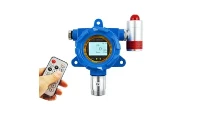

Gas detector is mainly a detection equipment that contacts the combustion gas sensor. It is composed of a platinum wire coil coated with alumina and adhesive to form a sphere. Therefore, care must be taken during installation to avoid breaking the detector. Fixed gas alarm detector is a safety instrument. If it has audible and visual alarm lights and display functions, it should be installed in a place that is easy to see and hear, so that hidden dangers can be eliminated in time. Such as combustible gas.
1. When using liquefied petroleum gas or a mixed gas with a specific gravity greater than 0.75, the horizontal installation distance between the gas alarm and the center of the release source should not be greater than 3m, and the installation distance between two detectors should not be greater than 6m. It should be installed in a corner where the air is not circulating. parts.
2. When using natural gas, artificial gas or mixed gas with a specific gravity less than 0.75, the installation distance between the gas detector and the center of the release source should not be greater than 4m, the installation distance between two detectors should not be greater than 8m, and the distance between the gas detector and the window should be greater than 0.5 m. When the space height exceeds 4m, a gas collecting hood or layered detectors should be installed. The gas collecting hood should be installed about 4m above the release source. The area of the gas collecting hood should not be less than 1 square meter. The detector should be installed in the gas collecting hood. When there is no gas collecting hood, the detector can be installed in two layers: the upper layer is within 0.3m from the top plate, and the base layer is about 4m above the release source.
3. When the confined space is long and narrow and its cross-sectional area is less than 4 square meters, the distance between the two detector devices should not be greater than 15m.

In a larger space, when gas equipment and gas appliances occupy only a part or are in strip shape, partial protection of the release source can be implemented. In open-air or semi-open-air places such as gas transmission and distribution reserve stations and gate stations, the detector should be placed on the dominant side of the annual minimum frequency wind direction of the combustible gas release source, and the distance between it and the release source should not be greater than 15m. When the detector is located on the downwind side of the minimum frequency wind direction of the release source, its distance from the release source should not be greater than 5m. When gas transmission and distribution equipment is located in a closed or semi-closed factory building, detectors can be installed every 15m, and the distance between the gas detector and any release source should not be greater than 7.5m.