


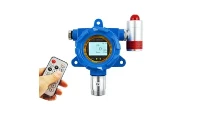

A volatile organic compound (VOC) online monitor is a device used to detect and monitor the concentration of volatile organic compounds (VOCs) in the environment. It is widely used in fields such as air pollution monitoring, industrial emissions monitoring, and environmental protection. VOCs are a class of volatile, easily evaporated organic compounds that exist as gases at room temperature. These substances pose potential hazards to air quality and human health, making VOC monitoring extremely important.
Common principles for online VOC monitors include photoionization detection (PID), non-deuterated infrared (NDIR), and electrochemical sensing.
1. Photoionization Detection (PID)
Photoionization detection is currently the most common method used in online VOC monitors. The principle is as follows:
Working Principle: The PID principle involves irradiating a gas sample with ultraviolet light from a UV light source (such as a deuterium lamp). VOC molecules are excited by the UV light, ionizing and releasing electrons. The number of ions in the gas is proportional to the VOC concentration. Ions are guided by an electric field and recorded by a detector (usually a galvanometer), which provides the VOC concentration.
Advantages: High sensitivity, capable of detecting low concentrations of VOCs. Furthermore, it is applicable to a wide range of organic compounds, and PID can detect most volatile organic compounds.
Disadvantages: Significantly affected by humidity and temperature, environmental factors may distort measurement results. Furthermore, it cannot distinguish between different VOC types, only detecting the total amount, and cannot accurately distinguish between individual VOCs.

2. Non-Dispersive Infrared Absorption (NDIR)
The NDIR method determines VOC concentration by measuring the absorption of infrared light of a specific wavelength by gas molecules. The principle is as follows:
Working principle: VOC molecules absorb infrared light of a specific wavelength. The instrument uses an infrared light source to emit a beam of light of a specific wavelength, which passes through the gas sample. The beam then passes through the detector, where the intensity of the absorption is measured. The degree of absorption is proportional to the gas concentration. NDIR is commonly used to detect components such as CO₂ and CH₄ in organic gases.
Advantages: Fast response time, suitable for online monitoring. Good stability and significantly unaffected by environmental factors.
Disadvantages: Can only detect specific gases and certain volatile organic compounds, not all VOCs. Limited resolution, making it difficult to distinguish gases with similar concentrations.
3. Electrochemical Sensing
Electrochemical sensing is a VOC measurement method based on the principle of electrochemical reaction. The principle is as follows:
Working Principle: Gas passes through an electrochemical sensor, where it reacts with electrodes, generating a current or voltage change. The magnitude of the current is proportional to the gas concentration. Electrochemical sensors generally have high selectivity and can distinguish between different types of VOCs.
Advantages: High sensitivity, capable of detecting low concentrations of VOCs. Furthermore, compared to other methods, electrochemical sensors are less expensive.
Disadvantages: Slow response, not as fast as methods like PID. Furthermore, electrochemical sensors have a limited lifespan and require regular replacement.
Different VOC detectors use different detection principles, each with its own advantages and disadvantages. In practical applications, the choice of principle mainly depends on the monitoring requirements, such as the type of monitored substance, sensitivity requirements, response time, and cost.