


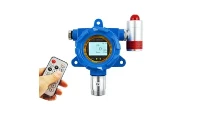

The wall mounted chlorine gas detector adopts advanced technology, is easy to operate, fully functional and highly reliable. The casing of the detector is made of high-strength materials and composite elastic rubber materials, featuring high strength and a good hand feel. The detector is equipped with high-performance imported electrochemical sensors, featuring high sensitivity and a fast response time. It can accurately and promptly detect and issue early warning signals to alert the operators and prevent accidents.
The measurement range of a chlorine gas detector is generally: 0-10 ppm or 0-20 ppm. Alarm Point 1 (low alarm) : 0.5-1 ppm (immediate action threshold); Alarm Point 2 (High alarm) : 1-5 ppm (Emergency evacuation threshold). The features as below.
1. Resolution
Low-range instruments: typically 0.01 ppm or 0.1 ppm (to ensure precise alarm)
High-range instruments: 1 ppm or higher (emphasizing rapid response)
2. Precision requirements:
For the low concentration range (<10 ppm), the error should be ≤±5% FS, while for the high concentration range, it can be relaxed to ±10%
3. Sensor type influence range
Electrochemical sensor: Most commonly used, covering 0-50 ppm (suitable for safety monitoring)
Semiconductor sensor: 0-100 ppm (low cost, weak anti-interference)
Ultraviolet absorption (UV) sensor: 0-1000 ppm+ (High precision, anti-poisoning, for industrial processes)

The portable chlorine gas detector is a mobile device with storage and printing capabilities that measures the concentration of chlorine gas in the environment and locates leakage points. When you don't know where the leakage is, you can take this instrument to find the leakage point. The area with a higher concentration is the leakage point. In terms of structure, it is a product where the display head and the detection probe are separated. It can be used for mobile detection like a handheld device or as an online desktop detection device, making it more suitable for specific locations.
The working principle of the chlorine gas detector is the electrochemical principle. The working mode of the sensor is to detect a certain amount of gas. Chlorine gas first passes through a sintered stainless steel filter and then enters the sensor interior through the breathable membrane on the sensor. Between the electrode and the electrolyte of the sensor, oxygen is consumed and a corresponding current is generated between the anode and cathode. When current flows inside the sensor, the lead positive electrode is oxidized to lead oxide, and the intensity of the output current has a linear function relationship with the concentration of oxygen. The sensor's rapid response capability enables it to continuously monitor air or process gases.
The use of chlorine gas detectors can effectively ensure the safety of personnel and production equipment. Chlorine gas detectors have been widely applied in industries such as metallurgy, petroleum, petrochemicals, chemical engineering, shipping, power, mines, and urban gas, and have become protective equipment in industrial safety production.