


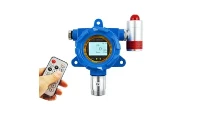

The full English name of LEL is Lower Explosive Limit. The Chinese explanation is "Lower explosive limit". In a combustible gas detector, LEL refers to the lowest concentration of combustible gas in the air that explodes when exposed to an open flame, which is 100%LEL. It is a technical term for flammable gases.
The range of general flammable gases is 0 to 100 percent LEL. For instance, the "lower explosive limit" of hydrogen is 4 percent volume ratio. That is to say, if this 4 percent volume ratio is divided into 100 equal parts, the 4 percent volume ratio corresponds to 100 percent LEL.
When the value of the combustible LEL EX gas detector reaches the 10% LEL alarm point. It is equivalent to the hydrogen content at this time being 0.4 percent by volume. When the detector value reaches the 25% LEL alarm point, it is equivalent to the hydrogen content being 1% by volume at this time. At this moment, the combustible gas detector went off the alarm.

It's not that the lower explosive limit has been reached, but rather a prompt that corresponding measures should be taken. For instance, first open the exhaust fan for ventilation, then cut off the flammable gas valve and check if there is any leakage of flammable gas. Early warning is conducive to timely handling of explosion risks and can prevent losses of life and property as much as possible.
When the concentration of flammable gas in the air reaches its lower explosive limit, we say that the explosion hazard of the flammable gas environment in this place is 100%, that is, 100% LEL. For instance, the lower explosive limit of methane is 5% by volume. That is to say, if this 5% by volume is divided into one hundred equal parts, the 5% by volume corresponds to 100%LEL. That is to say, when the detector value reaches the 10%LEL alarm point, it is equivalent to the methane content at this time being 0.5% by volume. When the detector value reaches the 25%LEL alarm point, it is equivalent to the methane content being 1.25% by volume at this time.
If the content of flammable gas only reaches 10% of its lower explosive limit, we say that the explosion hazard of the flammable gas environment in this place at this time is 10% LEL. The monitoring of flammable gases in ambient air often directly provides the environmental hazard degree of the flammable gas, which is expressed as the percentage of the content of the flammable gas in the air to its lower explosive limit: [% LEL]; Therefore, this kind of monitoring is sometimes also called "explosion detection", and the monitoring instruments used are also called "explosion detectors" or combustible gas detectors.