


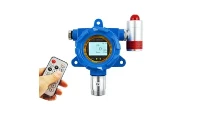

In industrial production, scientific research experiments and the wide application in specific living environments, hydrogen, as an indispensable energy source and chemical raw material, its significance is self-evident. However, its colorless, odorless and highly flammable and explosive properties make hydrogen pose significant safety hazards that cannot be ignored during its use and storage. Once hydrogen leaks and accumulates to a dangerous concentration, it may quickly trigger a fire or even cause a catastrophic explosion, posing a serious threat to the lives and property of people. Therefore, whether it is industrial workshops, laboratories, gas stations, hydrogen stations, or hydrogen refueling stations for new energy vehicles and other places, as long as there is a possibility of hydrogen presence, fixed hydrogen gas detector need to be equipped for continuous monitoring.
1. Principle of electrochemical sensor
This is one of the most commonly used hydrogen detection techniques. The electrochemical sensor contains an electrochemical cell inside, which consists of a working electrode (usually a precious metal such as platinum), a counter electrode, a reference electrode and an electrolyte. When hydrogen comes into contact with the working electrode, an oxidation-reduction reaction occurs, generating an electric current. The magnitude of the current is directly proportional to the concentration of hydrogen, so the slight leakage concentration (PPM) of hydrogen can be determined by measuring the current.
2. Principle of catalytic combustion sensor:
Catalytic combustion sensors detect hydrogen by utilizing the principle that hydrogen burns on the surface of a catalyst to generate heat. When hydrogen mixes with oxygen in the air and comes into contact with a catalyst, flameless combustion occurs, releasing heat. This heat change can be converted into an electrical signal for measurement, thereby determining the concentration of hydrogen. However, it should be noted that catalytic combustion sensors are typically used to detect the lower explosive limit (LEL) of flammable gases and may not be suitable for all hydrogen detection applications.
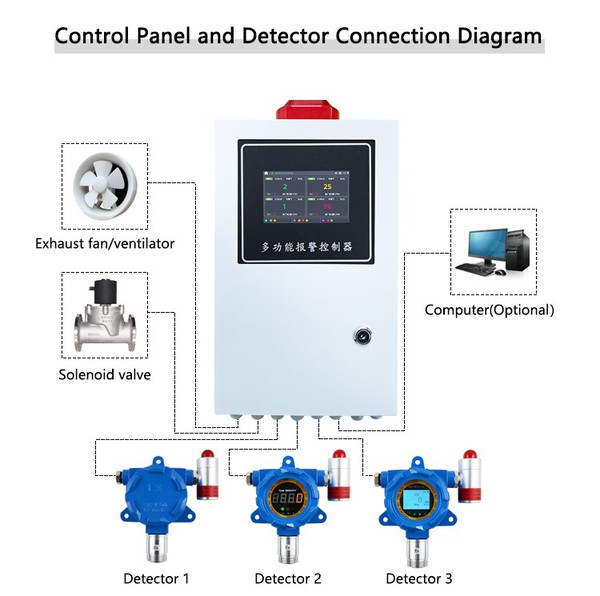
Our company has specialized in the production of gas detectors and control panels for over 20 years. The hydrogen detector is connected to the gas control panel via 4-20mA and RS485. The relay signals in the controller can be linked to external devices, thereby ensuring the safety of life and property.
(1).Exhaust system: It automatically starts when the concentration reaches 10%LEL (Lower explosive limit), forcing ventilation to dilute hydrogen and prevent accumulation and explosion.
(2).Shut-off valve: When the concentration reaches 20%LEL, it automatically cuts off the gas supply pipeline valve to prevent leakage from the source.
(3).Sound and light alarm: Simultaneously alarm the site and the control room to warn personnel to evacuate or handle the situation.
(4).Fire protection and public Utilities: The signal can be uploaded to the fire protection system and be linked to activate explosion suppression measures such as nitrogen purging and sprinkler cooling.